Cognitive Functions Explained Through the INTJ Example

Why I Started Studying Cognitive Functions
Cognitive functions are an area I am deeply passionate about.
Last year, I became determined to understand people better after facing challenges in my close relationships. Someone told me that if I understood MBTI, cognitive functions and the Enneagram, I would understand “~90% of people.”
I’m not sure if that number is valid. But learning about cognitive functions has been very helpful.
Unlike some personality frameworks, cognitive functions are not only about behaviour. They describe how someone thinks, perceives, evaluates and processes information. That makes the framework feel less context-dependent to me.
There is plenty of information out there, but I couldn’t find one that resonate with me. Perhaps that is an INFJ thing: reorganising scattered pieces of information into one interconnected system.
So this is my attempt to explain cognitive functions.
A Brief Background
Cognitive functions were first described by Carl Jung. His work was complex and not always easy to read, so later, Myers and Briggs built on his ideas and made them more accessible to the general public through what we now know as MBTI.
That is why MBTI and cognitive functions are connected. Each MBTI type has a cognitive function stack, which is basically the preferred order in which that type uses different mental processes.
So, What Are Cognitive Functions?
Cognitive functions describe the mental habits we use to understand the world and make decisions.
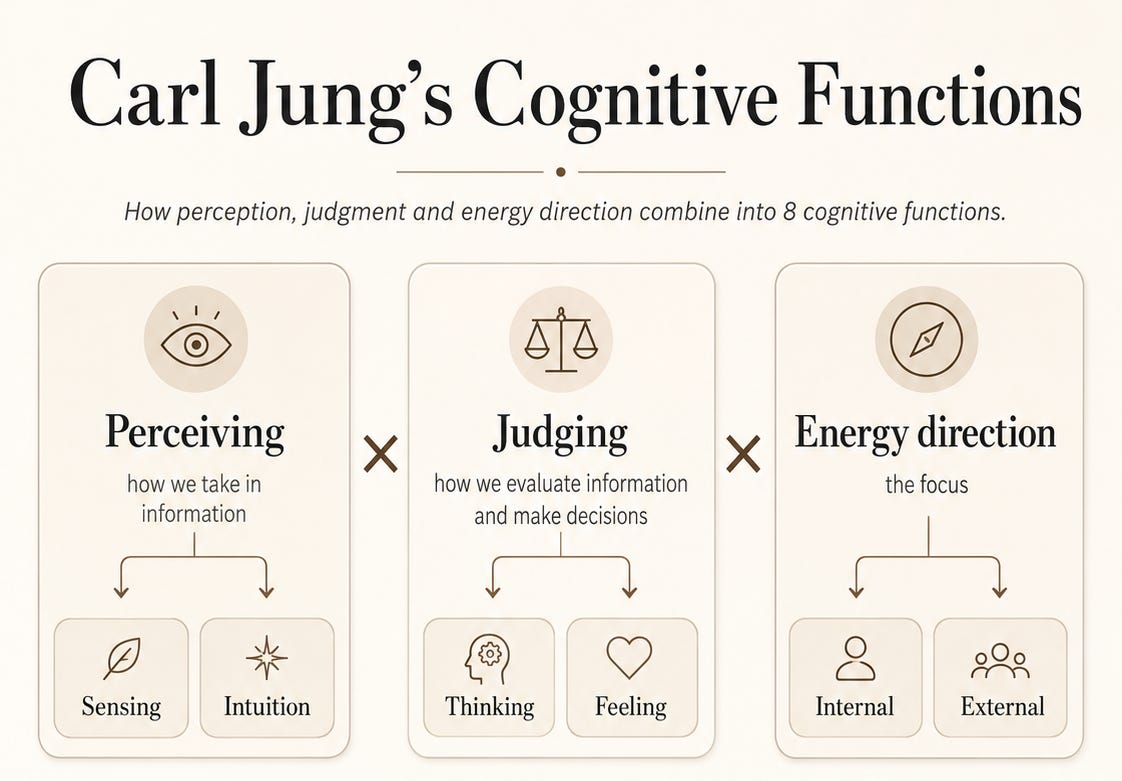
Jung described 4 main mental functions and 2 directions of energy.
There are two Perceiving functions, which describe how we take in information:
Sensing (S)
Intuition (N)
There are two Judging functions, which describe how we evaluate information and make decisions:
Thinking (T)
Feeling (F)
Each function can then be directed either inwardly (i) or outwardly/externally (e).
So we have:
2 Perceiving functions × 2 Judging functions × 2 energy directions = 8 cognitive functions
Before going further, I need to clarify something important.
In this context, introversion and extraversion do not refer to the usual social meanings of being quiet, loud, outgoing or charismatic.
In Jungian typology, introversion and extraversion refer to where attention and energy are directed.
Introversion means energy is focused inward:
What do I think? How do I feel? What is my path?
Extraversion means energy is focused outward:
What are others feeling? What is the group thinking? What is happening around us? What is our shared direction?
The Eight Cognitive Functions at a Glance
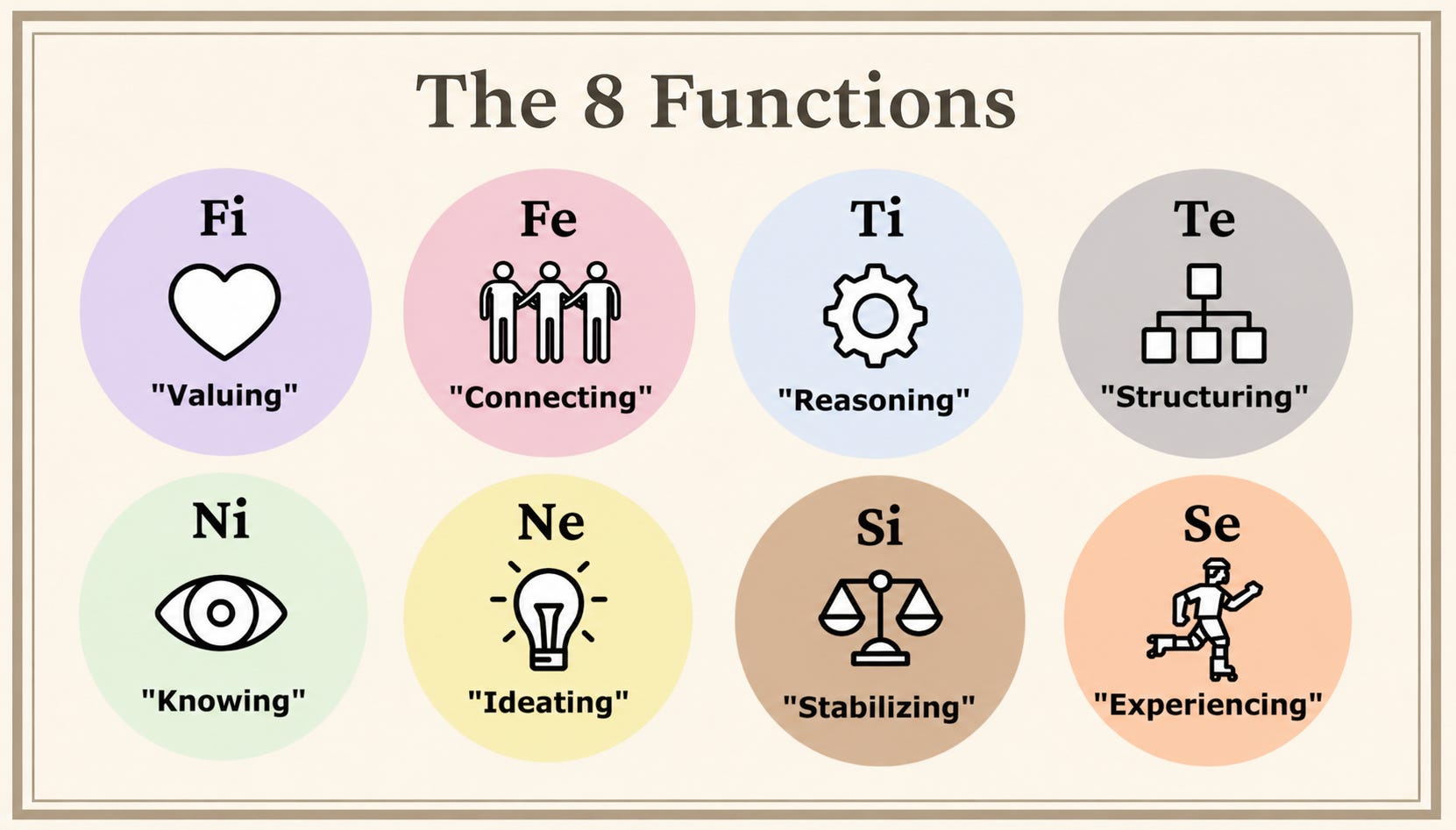
Cognitive functions are typically abbreviated by combining the mental process with the energy direction, e.g. Introverted Intuition (Ni), Extraverted Sensing (Se), and Extraverted Thinking (Te).
These words are only a guide to remember. Each function is more complex and interacts with other functions in the stack.
The Function Stack
Jung’s idea was that we naturally rely on some functions more than others.
Each MBTI type is associated with a preferred order of cognitive functions, commonly called a function stack.
The four main positions are:
Dominant → Auxiliary → Tertiary → Inferior
There are also shadow functions, which show how each type may think and behave under stress, but that is a topic for another day.
To make this clearer, let’s look at one type - INTJ.
I have previously explored the INFJ function stack, so I will use INTJ here as an example.
Disclaimer: I am not an INTJ. I have also formed close friendships with several INTJs over the years, and I have dated INTJs before. These relationships made me curious about the thought process beneath a personality that can initially appear private, independent and difficult to read.
Understanding an INTJ Through Cognitive Functions
The INTJ function stack is:
Ni → Te → Fi → Se
This means INTJs primarily process information through Introverted Intuition, make decisions using Extraverted Thinking, rely on Introverted Feeling for personal values, and use Extraverted Sensing as their weakest or least-developed function.
1. Dominant Function: Introverted Intuition - Ni (Vision)
Dominant function means one that the person use most of the time without much effort (almost subconsciously).
Ni processes information inwardly through patterns, impressions and underlying meaning. INTJs often see the big picture, detect abnormalities or pattern breaks, and anticipate where things may be heading.
Because Ni is introverted, much of this processing happens privately.
Other people may only see the final conclusion, not the complex internal synthesis that produced it. This is why it can sometimes be difficult for INTJs to explain every immediate step in their thinking. They may not even realise that other people do not process information the same way.
Compared with INFJs, who are also dominant Ni users, INTJs process patterns with less emotional filtering (auxiliary function of INTJ is extraverted thinking whereas INFJ’s is extraverted feeling). Their Ni is supported by Te, which helps them structure external data and turn insight into logical next steps.
This can make INTJs excellent problem-solvers: objective, strategic, practical and future-oriented.
However, because INTJs do not use Fe in their main stack, they may not naturally focus on group harmony in the same way INFJs often do.
Different functions. Different focus.
2. Auxiliary Function: Extraverted Thinking - Te (Structuring)
Auxiliary function is a strong function that a person use after the dominant function.
If Ni develops the vision, Te asks:
How do we make this work?
The INTJ’s Te looks for external evidence, efficient systems, clear logic and practical execution.
Fun fact: if someone uses words like “system,” “strategy,” “clarity”, they’re likely an INTJ.
Because the second function of INTJs is Te and not Fe, INTJs would prioritize logical effectiveness rather than seeking emotional consensus from everyone involved.
This does not necessarily mean they do not care. They focus on what needs to be done rather than what everyone wants.
3. Tertiary Function: Introverted Feeling - Fi (Values)
INTJs are often stereotyped as emotionless.
In my experience, it’s often not true. They can be deeply affectionate and idealistic once they let you in their inner circle. An INTJ may not express care through emotional language. They may express it through loyalty, honesty, problem-solving, protection or long-term commitment.
Their Feeling function is introverted and tertiary, which means their emotions and values may be deeply personal, but not always visible.
Their Fi can also make them more idealistic. Once they decide that something violates an important personal value, they may become surprisingly firm.
Note 1: never cross the personal values of INTJs or INFPs (dominant Fi).
It is also important to look at how functions interact with one another, not just each function in isolation.
Ni forms the internal vision.
Te decides how to execute it.
Fi checks whether it aligns with personal values.
Note 2: Because INTJs do not have Fe in their main stack, they are usually less affected by other people’s emotions than INFJs are.
This can make INTJs appear independent, authentic and emotionally self-contained.
4. Inferior Function: Extraverted Sensing - Se (Experience)
Se connects us with immediate sensory reality.
Because Se is inferior for INTJs, they may become so absorbed in future implications, internal models or long-term plans that they overlook what is directly in front of them.
I’ve had the longest debates with INTJs regarding the importance of presence. But we rarely come to any common conclusion. For my INTJ friends, thinking is meditating and part of the present moments. I’ll leave it at that because I don’t share the same cognitive function stack.
Final Thoughts
Cognitive functions are a helpful guide to understand people. Everyone is different and there are many factors influencing how someone shows up; e.g. childhood background, emotional maturity, age and gender.
The real value of studying personality is not to label people or create an identity, but to understand them with more clarity, compassion and nuance.
If you’re into cognitive functions, happy to exchange thoughts sometimes.
Thanks Kikyo, this is a very easy to understand yet comprehensive description of MBTI ! You’ve reminded me to find out my MBTI type, then come back to this article.
This is an excellent breakdown of the INTJ stack (especially the Ni-Te interaction and how Fi quietly anchors everything). Really insightful and spot-on. This is a bit long read but I was actually expecting it to be longer then saw the final thoughts... coz I know Jung's extraordinary conceptual thoughts are too deep, at least for me. I remember when I was in college and I could barely grasp his mind thru his writings until such time that I need to re-learn his works.